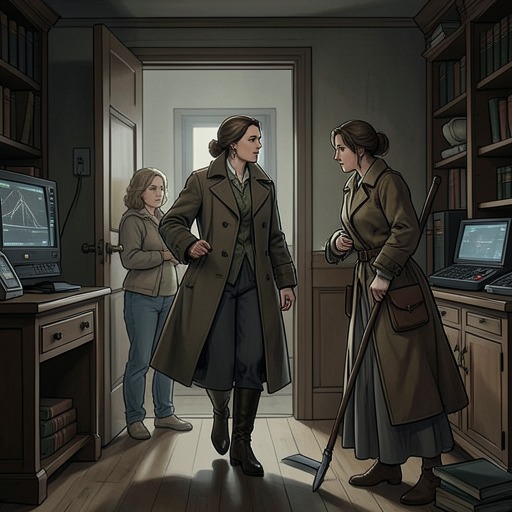
Fidelis and Tante’s sibling relationship
The Master Butchers Singing ClubFidelis and Tante’s sibling relationship binds family loyalty to work, immigration, and control of the household. In Argus, Tante is the only family Fidelis has nearby, while her presence helps sustain the life he built after leaving Germany. Their relationship reaches a decisive rupture when Fidelis tells her to leave so Delphine will return; the choice makes clear that kinship, however enduring, does not settle who can shape the household or claim a place in it.
Shared Family and Immigrant Obligations
Tante is Fidelis’s sister and, as he understands it, his only family in America. Her connection to their German relatives remains active through long letters: she writes detailed accounts of his life to Germany, and letters travel back across the Atlantic. She also keeps the family’s possible return to Ludwigsruhe in view, though she believes she cannot leave Fidelis alone in America, particularly while his boys need care.
Fidelis’s attachment to family extends beyond Tante. His parents and brother remain in Germany, and he misses them, but he has made a life in North Dakota by working relentlessly. After his parents recovered a property that had belonged to them before the war, they sent him money from his share. He used it to buy a farmstead and open his shop, then labored long days to bring Eva, Franz, and eventually Tante to live with him. His history gives Tante’s presence practical as well as emotional weight: she belongs to the family he has gathered around the business and the household he has struggled to maintain.
That history also makes the sibling bond unequal in its obligations. Fidelis shoulders the work and responsibility of the business, while Tante’s correspondence keeps the family’s German ties before him. He reads the letters, but sets them aside before they reach what the narrative describes as his still center, where loneliness might be felt. The letters connect him to home, yet they do not make a return possible; the work and family he has built in America hold him in place.
Conflict Over the Household
The relationship becomes strained as Delphine becomes part of the Waldvogel household. When Fidelis asks Delphine when she will come back, he says only that Tante cannot run things alone. Delphine recognizes that even this mild criticism of his sister is a breach of family loyalty. In her understanding, Tante is not merely a difficult housemate but the one relative Fidelis has in America, a woman whose letters to Germany record his actions in meticulous detail.
Delphine responds by making her return conditional on Tante’s departure. She points to concrete failures in the household and business: Tante cannot cook, treats customers rudely, and leaves Fidelis looking poorly cared for, while the boys are running wild. Delphine says she will not return if Tante remains. The demand turns a general appeal for help into a direct choice between the sister who has shared Fidelis’s immigrant household and the woman whose labor and presence he needs.
Tante sees Delphine as a threat not only to her domestic position but to her standing in the community. She gathers and circulates hostile details about Delphine’s background, religion, and reputation, portraying her as an outsider who has taken advantage of Eva’s illness and hopes to gain a place beside a widower with a business and sons. Tante’s judgment mixes personal resentment with the social categories through which she condemns Delphine. Her opposition therefore reaches beyond a quarrel over chores: Delphine’s arrival unsettles Tante’s authority over the household and her sense of her own place in Argus.
The Break and Its Cost
Fidelis eventually tells Delphine that he has ordered his sister to leave. He delivers the news in person, looking depleted and asking her to listen. Delphine understands the magnitude of what he has done: he has chosen her return over his bond with his sister. She also recognizes the consequences. Tante, formerly hostile and rigid, will now have reason to seek revenge, and may try to turn the family against her brother.
The decision is not presented as an easy release from an unwanted relative. Fidelis has already been reluctant to criticize Tante, and her letters connect him to a family in Germany that he cannot visit. Asking her to go means disrupting both his household and one of the remaining ties to his old country. At the same time, he does not reverse the decision when Delphine checks that Tante will not come back. His weary manner gives no sign that he intends to turn the choice into a claim on Delphine; she notices the possibility but finds only exhaustion in his expression.
Relationship and Narrative Significance
Tante’s resentment grows after her brother dismisses her. She continues to press the letters from Germany on him and wants him to acknowledge her accusations against Delphine, but he waves them away. She cannot openly attack him without risking damage to his business, so her anger accumulates. She imagines returning to Ludwigsruhe with some of the boys, not alone but as their guardian, a role that could restore her status in her former community. The fantasy shows how the rupture sharpens her concern with belonging and social standing, while turning family care into a possible route back to Germany.
The siblings’ conflict also clarifies the costs of the family life Fidelis has made in America. He has built a home around work, marriage, and children while remaining separated from his parents and brother. Tante’s letters preserve the distant family’s claim on him, but Delphine’s return requires him to decide who can live within the household he has created. His choice does not erase his history with Tante; it makes that history visible as a genuine sacrifice rather than an abstract duty.
Their relationship is thus defined by both connection and division: they share family origin, migration, and the pressure of caring for the next generation, yet disagree over who belongs in Fidelis’s home and who may determine its future. Tante’s departure is the turning point. It gives Delphine a way back into the household, but leaves Fidelis facing the emotional and familial consequences of having chosen that future over the sister who was, in America, his only family.